Sell in May & Go Away | Keeping Connected
May 14, 2026
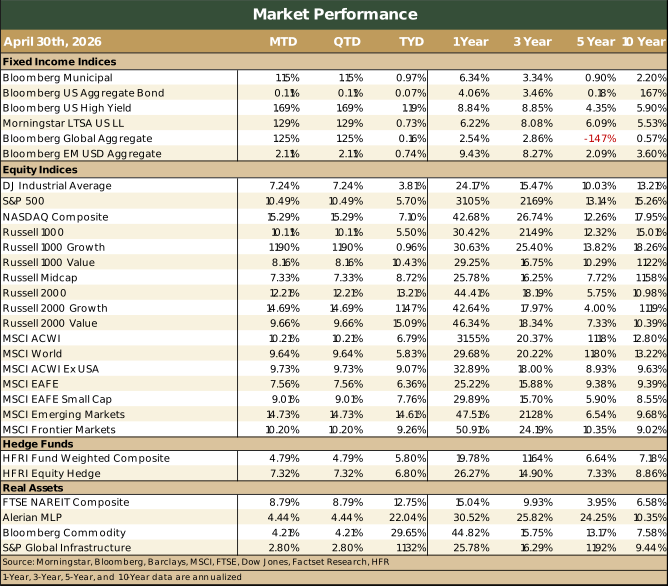
"Sell in May and go away" – it's one of Wall Street's oldest seasonal adages, and yet April's market performance made a compelling case for ignoring it entirely. U.S. equities delivered one of their strongest monthly showings in recent memory, with the S&P 500 surging 10.49% and the NASDAQ leaping 15.29%, capping off a sharp C-shaped recovery from March's turbulence. The rebound was broad-based, spanning market caps and geographies, as international markets added to strong local gains amid U.S. dollar weakness. Underneath the surface, the fundamentals are holding up better than many feared: Q1 GDP grew 2% year-over-year, corporate earnings came in at a staggering 27.7% growth – nearly double analyst expectations – and employers added a better-than-expected 115,000 jobs in April.
Globally, the picture was more nuanced: China's economy picked up steam in Q1, with 5% GDP growth, as robust exports offset sluggish domestic consumption, while Taiwan posted its fastest expansion since 1987- up 13.7% - fueled by surging demand for AI-related exports. In contrast, the Eurozone slipped back into contraction territory, with the composite PMI falling to a 17-month low of 48.6 and inflation rising to 3% in April, its highest level since September 2023, amid the Iran conflict weighing heavily on the services sector. Japan, meanwhile, saw bond yields climb sharply as the 10 -year JGB hit 2.5%, driven by rising inflation expectations and growing market pressure on the Bank of Japan to reconsider its policy stance. To be sure, risks remain: the Iran conflict is clouding the global energy and inflation picture, and U.S. valuations are elevated. But for investors who stayed the course through March's volatility, April was a powerful reminder that trying to time the market's seasonal patterns can mean missing its best days.
Economic Growth & Employment Post Strong Rebounds in April
First-quarter U.S. GDP grew 2% Y/Y, well ahead of the 0.5% rate reported in Q4 of 2025, but the reading slightly missed Wall Street expectations. The main contributors to the Q1 GDP growth were investment, exports, consumer spending, and government spending. Imports increased in Q1. Business investment, driven largely by the AI boom, rose 8.7% on an annual basis, and consumer spending, which drives nearly two-thirds of economic activity in the U.S., slowed slightly from last quarter, falling from 1.9% at the end of 2025 to 1.6%. While the economy has remained resilient, the war in Iran is clouding the outlook. Thus far, most economists pin the impact from the Iran war and higher oil/energy prices at a 0.3 drag on 2026 GDP growth.
U.S. employers added a better-than-expected 115,000 new jobs to the economy in April, ahead of the 55,000 forecast. The unemployment rate held at 4.3%, further proof that the labor market has reached a point where only modest job creation is needed to keep the jobless level steady. Average hourly earnings came in lower than expected, increasing 0.2% M/M and 3.6% Y/Y. The broader U6 unemployment rate did tick higher to 8.2%, and the labor participation rate fell again to its lowest level since October 2021. This was a solid report, and the low-hire, low-fire environment continues.
Americans have been hit hard by the surge in energy prices. The latest PCE Index report showed that headline prices rose 0.7% M/M or 3.5% Y/Y in March. Core PCE jumped 0.3% M/M and 3.2% Y/Y. The bulk of the price pressure came from goods, which rose 1.4%, boosted by an 11.6% surge in energy goods and services. Service prices overall rose 0.3%. The April CPI report showed headline inflation increased at an annual rate of 3.8%, with core CPI rising just 2.8%. This was the highest CPI reading since May 2023.
Consumers and Businesses Keep Spending
U.S. retail sales rose 1.7% in March after an upwardly revised 0.7% increase in the prior month. This marks the steepest growth since March 2025, driven largely by a record 15.5% surge in gasoline station receipts amid a spike in fuel prices due to the escalating conflict with Iran.
Despite rising pump prices, consumer spending remained solid across nearly all categories, likely boosted by larger-than-usual tax refunds. Core retail sales, excluding volatile sectors, climbed 0.7%. New orders for durable goods rose 0.8% in March. The large headline gain occurred despite a 21.1% drop in commercial aircraft orders. Orders excluding transportation increased 0.9% in March and 7.6% Y/Y.
Core shipments input for business investment in the calculation of GDP – rose 1.2% in March and were up an 8.3% annualized – a key input for business investment in the calculation of GDP – rose 1.2% in March and were up an 8.3% annualized rate in Q1 versus the Q4 average. Business investment has consistently risen since mid-2025, driven by a more favorable tax environment and AI spending.
Corporate Earnings are Quite Remarkable
Through 90% of the Q1 earnings season for the S&P 500, earnings have come in well ahead of expectations. Analysts expected 13.1% Y/Y growth in Q1, but companies have reported a staggering 27.7% Y/Y growth. This would mark the highest level of growth since Q4 2021. The headline numbers are impressive; most of the upside has come from hyperscalers and companies leveraged to the global AI trade.
For the full year, earnings are forecast to grow 21% and 15.3% in 2027. Energy, tech, materials, and communication services are expected to see the strongest rates of growth in 2026. Valuations are elevated within U.S. equities, so strong earnings should help provide an added boost to prices. 2026 was supposed to be the year of the S&P 493 catching the Mag 7 on earnings growth, but that has not exactly been the case thus far.
Eurozone Growth and Business Activity Weakens, Inflation Jumps in Europe & Japan
After 16 consecutive months in expansion territory, the eurozone composite PMI dipped back below 50 into contraction. The headline reading of 48.6 was down from 50.7 in March, representing a 17 -month low. The service sector fell to a 62-month low, while the manufacturing sector hit a 47-month high. April’s flash PMI has moved into contraction territory for the first time since late 2024, signaling a 0.1% quarterly rate of GDP decline after a 0.2% gain had been signaled for Q1. The war is hitting the service sector hardest, where business activity is falling at a rate not seen since the early 2021 pandemic lockdowns.
Eurozone GDP grew by 0.1% Q/Q in Q1 2026, down from 0.2% growth in Q4 2025. On an annual basis, the eurozone economy expanded by 0.8%, with manufacturing and energy shocks contributing to the sluggish performance. Eurozone inflation hit 3% in April, the highest reading since September 2023. Services inflation increased 3% amid a 10.9% surge in energy prices.
Japanese bond yields have been jumping higher on the back of higher inflation readings and expectations. The 10-year JGB hit 2.5% last week, driven by the war in Iran and core inflation, which hit an annualized clip of 2.4%. While the BoJ in March indicated it would keep the current policy rate at 0.75%, a growing consensus has formed that the central bank must swiftly raise the policy rate if underlying inflation remains above 2%.
China's GDP Picks Up Q1, Chip Sales Fuel ≈14% Growth Surge in Taiwan
China's economy gathered steam in the first quarter, as robust exports offset sluggish domestic consumption. GDP grew 5% Y/Y in Q1, up from the 4.5% rate reported in the final quarter of 2025. For the full year, China has lowered its growth target to a range of 4.5 -5%.
The real estate downturn persisted in Q1, with investment falling 11.2%, an acceleration from a 9.9% drop during the same period last year. In addition, retail sales rose 1.7% Y/Y in March, and industrial output expanded 5.7%. In the first quarter, China's exports grew 14.7% year over year in U.S. dollars, the fastest pace since early 2022.
Taiwan's economy expanded 13.7% in Q1 of 2026, the fastest pace since 1987, fueled by soaring demand for AI -related exports. Several economists have raised their 2026 growth estimates to the 8% range, up from 6.5 -7%. Exports surged on robust demand for AI, cloud infrastructure, and new high -end product ramps, with real exports of goods and services up 35.25% Y/Y.
How Long Can Oil Stocks Last?
The Iran War has choked off trade traveling through the Strait of Hormuz. A large share of oil/energy and fertilizer flows through this part of the world to consumers and farmers worldwide. Oil prices have surged higher since the start of the war, and fertilizer prices have also jumped, putting farming and food supplies at risk. Strategic reserves are abundant today, but the longer this crisis lasts, the greater the impact on the global economy could be.
Market Review
- U.S. equities posted an exceptional month with broad-based gains up and down the market cap spectrum. Tech/AI stocks led the rebound. Growth beat value in April, and small caps outpaced large caps.
- The March selloff brought tech valuations more in line with the broader market, and that was compelling for investors.
- Stocks outside the U.S. generated solid gains in April in local terms but received an added boost from USD weakness.
- As in the U.S., small caps beat large caps across EAFE markets, and growth outperformed value.
- Within EMs, small caps lagged large caps.
- U.S. dollar weakness boosted EAFE returns by 237 bps in April and EM returns by 145 bps.
- Yields on the 10 -year Treasury and other global sovereign debt fell in April, providing a nice boost to core fixed income and municipal bonds.
- After some minor spread widening during the March selloff, credit spreads tightened in April, driving another month of clipping coupons.
- Bonds outside the U.S. posted modest gains in April on the heels of spread compression and modest U.S. dollar softness.
- Hedge funds broadly gained 4.8% in April, led by strength in equity-sensitive strategies like equity L/S and event-driven. Macro and relative value also posted more modest gains last month.
- Real assets posted strong gains in April, led by REITs, MLPs, and commodities. Real assets have provided great diversification YTD.
- April was an exceptional month, capping off a strong V -shaped recovery from March's sharp drawdown. It is crucial to remain invested during periods of volatility, as markets tend to move higher over time.
Note: For informational purposes only. Not an investment recommendation. The views expressed are those of Meramec Financial Planners LLC's advisory representatives as of the date of this newsletter. Opinions and any forward-looking statements expressed in this newsletter are subject to change without notice and are not guarantees of future performance. Historical performance figures for the indices are provided for illustrative purposes only and do not represent any actual investments. Index performance assumes reinvestment of distributions. The Indices are unmanaged, and you cannot invest directly in an index. Past performance is no guarantee of future results. Diversification does not assure or guarantee better performance and cannot eliminate the risk of investment losses.